Have you ever watched a child perform in a school play? Dance or sing on a stage? Have you noticed how did they respond to their audience clapping and cheering them on? Usually, you can tell they are proud of themselves and if you are lucky you will be able to catch a big smile on their faces. I remember feeling powerful and so good about myself as a child after a piano or dance recital, because I accomplished a goal or learned a complex task. It built my sense of self. And the more I learned the better I felt about my talents and capabilities. But at some point, in our adolescence or adult lives, traumatic events can make us self-doubt or question our abilities. Faced with difficult events, adults can struggle to find solutions for adverse unexpected situations. For instance, teenagers may start comparing themselves to others, and we feel inadequate or a failure for not being able to perform as well under pressure , stress or loss. Our inner child becomes afraid and our self-esteem can be affected.
Our self-esteem is a trait we build on from early childhood. Contrary to popular belief, we are not born self-confident. Several factors can contribute or interfere with children’s and adult’s self-esteem. During our early childhood , if we have a supportive community, we are encouraged to develop skills which in turn make us feel good about ourselves, make us feel powerful and capable.
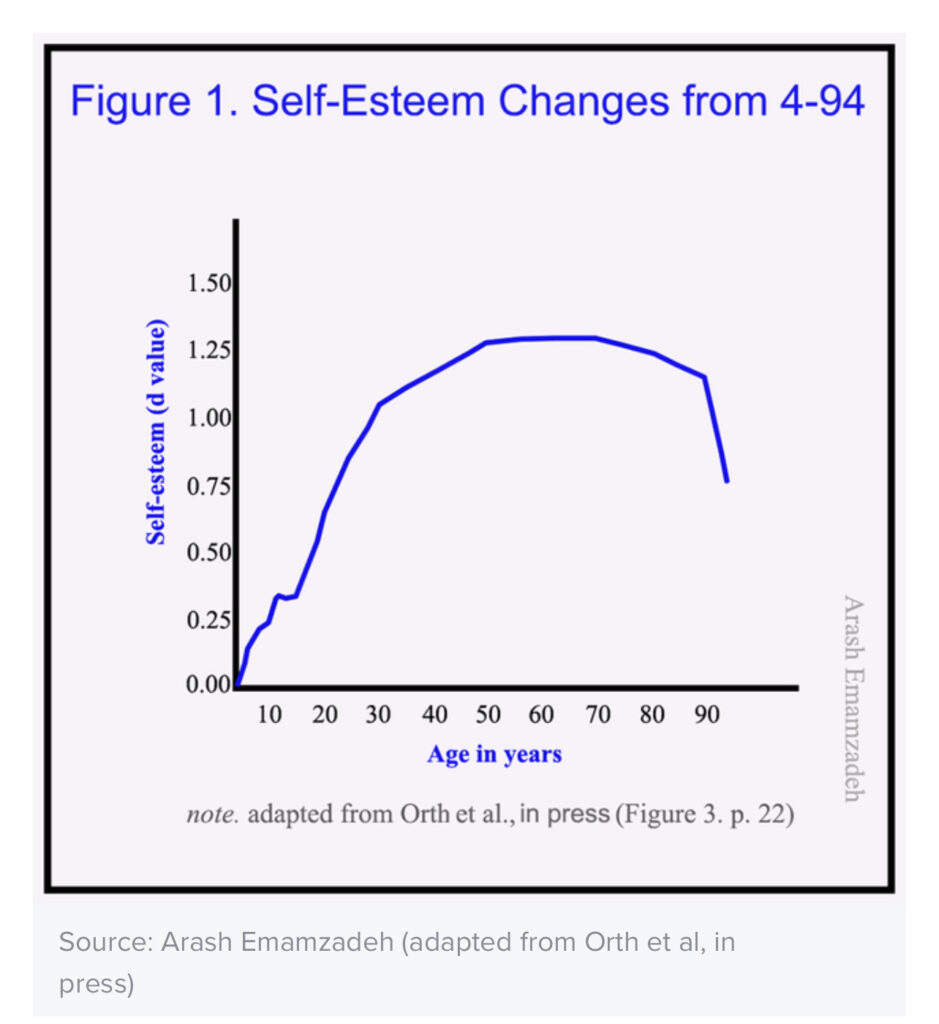
Studies show that self-esteem increases quickly up to age 30, these are the years that most of us are in school and building careers, learning complex roles. Self-esteem continues climbing but slightly more gradually up to age 60, and the sharp decline happens around age 90.
Self-esteem reflects a person’s physical self-image, view of their accomplishment and capabilities, and values and perceived success in living up to them, as well as the ways in which others view and respond to their person. The more positive the cumulative perception of these qualities and characteristics, the higher one’s self-esteem.”
According to an article by Beth Sissons on Medical News Today, several factors can directly affect one’s self-esteem or confidence such as but not limited to:
Work or school performance results
Pressure to excel from social media
Body image
Community support
Skill levels
Achievements
Pressure to fit in
Perfectionism
Bullying from school or work peers
Abusive environment
Discrimination
Family or relationship struggles
There are also additional factors which can negatively impact one’s self-esteem and mental health such as:
Excessive harsh criticism from parental or authority figures
Mental health disorders
Physical disabilities
Childhood trauma such as divorce or abuse
Emotionally distant parents
All of us at some point in our lives may experience negative feelings about ourselves, but if these feelings are persistent and are preventing us from achieving our full potential in all areas of our lives, then it is crucial to recognize the signs and seek professional help.
Our inner child is the part of us who carries emotions we experienced in our childhood. Having self-compassion and the ability to recognize any emotional wounds from childhood can help us move towards healing and develop a stronger sense of self, improving confidence and self-esteem.
Be kind to yourself
SIGNS OF LOW SELF-ESTEEM:
These are some of the most common signs of low self-esteem:
Constant negative self-talk
Self-doubting your own achievements
Difficulty in receiving compliments
Taking blame for other’s mistakes
Fear of challenges
Sensitivity to criticism
People pleasing
Fear of failure
Social withdrawal
Unhealthy habits such as alcohol or drug abuse
Sometimes even with the support of our loved ones, we find ourselves struggling to get out of difficult emotional situations. It’s a sign of courage to ask for help. A trained therapist can help clients discover their full potential and achieve success and accomplish goals.
HOW CAN THERAPY HELP REBUILD SELF-ESTEEM FROM WITHIN:
By providing a safe and nonjudgmental space, therapy is not only effective but also a neutral environment for clients to regain their self-esteem and confidence. Most important benefits from therapy to regain self-esteem are:
Manages negative thoughts and emotions
Develops coping mechanisms
Explores new hobbies and interests
Improves self-image
Builds self-acceptance
Explores past trauma experiences
Helps build support systems
Encourage growth
Set realistic goals
Improves or develops social skills
Teaches self-compassion exercises
TYPES OF THERAPY FOR REBUILDING SELF-ESTEEM:
While there are several different therapeutic approaches to self-esteem focused therapy, these are the most recommended:
Cognitive-Behavioral Therapy (CBT): Although cognitive behavioral therapy is suitable to a variety of psychological issues, it is particularly suitable for self-esteem improvement because self-esteem is maintained by cognitive factors. This approach involves cognitive restructuring by replacing negative thinking patterns by more appropriate positive thinking and behaviors.
Narrative Therapy: With this approach, the therapist encourages their clients to detach their problems from their identities. This creates a space allowing individuals to develop self compassion and a better and more clear understanding of their self-esteem struggles. Leading to healthier coping mechanisms and the recognition of their own power and abilities.
Compassion-Focused Therapy (CFT): This approach aims to encourage individuals to treat themselves with the same amount of compassion and care they treat others. It encourages self-acceptance which brings stress levels down and clients can focus on developing new paths to healing their inner child trauma experiences and improve their self-esteem.
Group Therapy: It helps clients connect with others who may be experiencing the same or similar negative feelings and low self-esteem. This experience may alleviate feelings of loneliness and isolation, giving clients an opportunity to share their own struggles and replace with a more empowered sense of self.
Psychodynamic Therapy: This long term type of therapy was developed from psychoanalysis and involves a therapist working with clients to explore between the unconscious part of our minds and our actions. It examines individuals deep thoughts and emotions that may be negatively impacting their self-esteem.
If you are experiencing a mental health crisis, always seek professional help immediately. Please call 911 or the suicide prevention lifeline at 988 or go to your local emergency room for immediate attention.
Celebrate all your achievements, even the small ones, they are the stepping stones to the big ones!
It’s not about feeling confident all the time, it’s about feeling aware that we as humans experience challenges all the time as part of our evolutionary process. It’s about enjoying our spiritual growth, which includes not only achievements but most importantly our failures and shortcomings. That’s when real learning and evolution happens. That’s when we should feel most proud of ourselves.
Failure does not mean defeat, it means opportunity for learning and growth.
I don’t believe in being perfect. I believe in embracing our humanity and our flaws and strengths, our uniqueness and differences as the only way to feel the real power that it is within all of us, the beautiful power of self-love.
You are a miracle. A miracle of nature and nature never makes mistakes.
Take a deep breath. There is so much beauty inside of you waiting to be unraveled.
Ana Brown is a Mental Health Content Writer. She holds a B.A. in Psychology, is fluent in English, Portuguese and Spanish. Ana believes we can all heal through meaningful connections. Live your best life.
National Suicide Prevention Lifeline: Call or text 988
DISCLAIMER:
The content of these webpages and blogs and information provided is for general information and educational purposes only and is not intended as a substitute for professional medical or mental health advice, diagnosis, or treatment. Always seek the advice of your qualified health provider with any questions you may have regarding any medical or mental health condition. Seek professional help immediately if you are experiencing a mental health crisis or any other medical condition.
I live in a major city and cannot escape driving on highways. If I don’t take the highway then it takes me forever to get anywhere. But even with faster roads and GPS, sometimes I make the wrong turn, or there is an accident which slows traffic down and I arrive late. It happens. It’s life, for some reason or another some of us arrive at our desired destination a bit later in life.
Many circumstances in life can delay us from achieving our full identity and personal goals before our 50’s or 60’s. Some of us choose to follow common paths such as a career, marriage, children and all of these events that can take up most of our young adulthood. Most of us spend years trying to build a life so focused on family and careers that at some point we forget our own identity and what is true life purpose. It’s very common to experience feelings of loneliness, loss of identity and lack purpose after children grow up and move out, after retirement, divorce, death of a loved one, a serious medical issue and many other life changing moments.
The term “Late bloomer” for adults can be described here by Wikipedia:
A late blooming adult is a person who does not discover their talents and abilities until later than normally expected. In certain cases retirement may lead to discovery.”
Midlife can be a difficult transitional for many people and can negatively impact one’s mental health. Some stressors associated with midlife stage are:
Increased risk of depression
Increased risk of anxiety
Hormonal alterations
Perception of failure
Adjustment difficulties
Cognitive changes
Loneliness
Social Isolation
Body image issues
Financial hardships
Aging parents
Empty nest syndrome
Science and technology has come so far in the last century extending our life span much longer than our great grandparents could have ever imaged. This very notion should prompt us to believe that middle age no longer means old. Some of our abilities and talents although pre-wired in our brains take years to fully come to fully develop. According to an article by Scott Barry Kaufman published on the magazine Psychology Today about late bloomers “In the brain, information gets passed through wires called axons. Helping the wires deliver the information is a fatty coating called the myelin sheath. Myelin speeds the transmission of information, but knowledge itself, and the proliferation of nerve connections and circuits by which we access it, depend on the acquisition of experience. And that takes time. Humans don’t even reach their peak myelin volume until their 50’s.“
In summary, late blooming should be a time when we all feel self-confident and prepare to start our second chapter in life and embark in new adventures and enjoy all the results of the hard work put into our careers and family in our younger years. What research shows is a different reality, the majority of late bloomers are faced with many challenges during a mid life transition. One of the main struggles late bloomers face, is finding themselves or a new identity later in life. After years dedicating our lives to others or careers, or perhaps having experienced traumatic losses, it can be difficult to navigate alone a new journey of self-discovery during a new stage in life.
Self-discovery is an ongoing journey not a destination.
Seeking professional help from a psychologist can help clients discover their full potential and utilize a lifetime of experience into a new season of blooming into their true selves.
HOW CAN THERAPY HELP LATE BLOOMERS FIND THEMSELVES :
Some of us have spent years being parents and caregivers, professionals with a full time career, but these roles may have come to an end, whether your children have grown up or it’s time for retirement. The loss of a lifetime identity can result in several mental health struggles and therapy can shine so much light into anyone’s path crossing these life transitional phases. Additional topics that therapy can help late bloomers with:
Understand untapped potential
Explore new identity or identify confusion
Address fear of failure
Encourage personal growth
Improve relationships
Build authentic confidence
Find new purpose in life
Reevaluate societal expectations of success
SOME TYPES OF THERAPY FOR LATE BLOOMERS:
Cognitive Behavioral Therapy (CBT): Helps clients recognize negative thinking patterns and behaviors that may result in low self-esteem and feelings of failure.
Eye Movement Desensitization and Reprocessing(EMDR): Helpful for clients processing trauma from their past.
Family Therapy: It helps individuals improve communication skills, reduce conflict and help late bloomers understand their new path and family dynamics at a different stage in life.
If you are experiencing a mental health crisis, always seek professional help immediately. Please call 911 or the suicide prevention lifeline at 988 or go to your local emergency room for immediate medical attention.
Therapy can empower clients to take on new careers, hobbies and interests giving them new purpose and meaning. Having something positive to look forward to and discovering what truly makes us happy later in life prepare us for a healthier and a more fulfilled time during the late blooming years.
Personal fulfillment in later years can be achieved through self-discovery and owning your own time line for success. Let go of society unrealistic expectations that we all must follow the same path to success and personal achievement. We are all unique and will have to face different challenges in life. Embracing your uniqueness and allowing yourself to start a new chapter can be incredibly rewarding. Therapy can offer a safe space for clients to reflect, grow and transform themselves into their better versions later in life.
Life transitions are only opportunities to learn and conquer a new identity. A new chance to reinvent yourself, this time with a wealth of knowledge, a decreased chance of making mistakes and the joy to know that aging is a privilege to be cheered not feared.
Every season in life brings a bloom of new chances to finding the new you.
Ana Brown is a Mental Health Content Writer. She holds a B.A in Psychology and speaks English, Portuguese and Spanish. She believes in healing ourselves through meaningful connections.
National Suicide Prevention Lifeline – Call or text 988
Crisis Text Line – text HOME to 74141
DISCLAIMER:
The content of these webpages and blogs and information provided is for general informational and educational purposes only and is not intended as a substitute for professional medical or mental health advice, diagnosis, or treatment. Always seek the advice of your qualified health provider with any questions you may have regarding a medical or mental health condition. Seek professional help immediately if you are experiencing a mental health crisis or any other medical condition.
she strolls around the park with her new baby, she watches the other moms play with their kids, smiling, giggling and she smiles back. Her baby sleeps peacefully on their way back home, she has a loving partner, a supporting family, and the dream of being a mom just came true. But for a while now, she feels disconnected from her own child, overwhelmed with sadness instead of the happiness that everyone expects new moms to feel. She cries alone ashamed of her own feelings, scared to share and be judged. Afraid she is not capable of caring for her child. She simply cannot bond with her baby.
Postpartum depression does not discriminate against backgrounds or socioeconomic status. It can happen to any mom and it is a serious condition that needs professional support.
WHAT IS POSTPARTUM DEPRESSION (PPD)?
The The Cleveland Clinic defines postpartum depression as “a type of depression that happens after you give birth.Postpartum depression doesn’t just affect the birth mother. It can affect surrogates and adoptive parents.”
It’s normal to experience “baby blues” after childbirth, but if you are experiencing severe and prolonged sadness or loneliness, constant mood swings and crying, extreme irritability and difficult regulating emotions, and other symptoms listed below, you may have postpartum depression.
POSSIBLE CAUSES OF POSTPARTUM DEPRESSION:
There are multiple causes associated with the onset of postpartum depression symptoms. It is a complex condition that requires medical and psychological support. Some possible causes are but not limited to are:
Hormonal changes/alterations : During pregnancy reproductive hormones increase tenfold followed by a dramatic drop in hormonal levels such as estrogen and progesterone right after childbirth . Hormone levels should start normalizing after 3 days of giving birth. If the leveling fails the drastic alteration can result in important and sudden mood swings as well as depression.
Life stressful or unexpected events: death of a loved one, extreme financial hardships, divorce , extreme loneliness, lack of support from family, friends and a community, medical life threatening conditions.
history of mental health disorders: there is an increased risk of developing postpartum depression if client has previously been diagnosed with depression or anxiety.
Relationship issues: childbirth and relationship difficulties can be overwhelming when experienced at the same time. Having a new born baby at home and having to deal with serious issues with a partner, can greatly increase the risk of developing postpartum depression.
Physical or psychological trauma: such as domestic violence or traumatic childbirth, or any other event threatening to the physical and emotional integrity of the parents, family or the child.
SYMPTOMS OF POSTPARTUM DEPRESSION:
Sometimes postpartum depression may be misdiagnosed as baby blues, which can put the lives of the new mom and baby at risk. It’s important to know the different and when to get professional help.
According to The Mayo Clinic the most common long lasting symptoms (more than two weeks)that can be an indication of postpartum depression include but are not limited to:
Depressed mood or severe mood swings
Constant crying
Feeling disconnected from your baby
Social isolation
Changes in appetite
Insomnia or sleeping too much
Overwhelming tiredness
Loss of interest in activities previously enjoyed
Intense irritability
Anger
Fear you’re not a good mother – shame and guilt
Hopelessness
Lack of concentration
Anxiety
Panic attacks
Serious intrusive and negative thoughts of harming yourself or the baby.
Recurring thoughts of death or suicide.
You matter.
Don’t allow shame or guilt prevent you from seeking support.
BABY BLUES SYMPTOMS:
John Hopkins Medicine lists the following common symptoms of postpartum baby blues which are common to up to 85% new moms, and contrary to the postpartum depression symptoms, baby blues symptoms only last a few days to a week or two after childbirth, and they may include:
Anxiety
Constant crying
Restlessness
Mild and temporary depression
Postpartum depression can last for months even years, John Hopkins reports one study shows that 25% of participants were still experiencing depression three years after having their children. This is an important alert to seek professional help right away.
It is important to note that every mother will experience postpartum depression in a different way. Postpartum depression can range from mild to severe and seeking help can save people’s lives.
If you have thoughts of harming yourself or your baby, or have recurrent thoughts of death or suicide, seek professional help immediately. Talk to your doctor and your therapist to determine the best course of treatment for you.
HOW CAN THERAPY SUPPORT NEW MOTHERS DEALING WITH POSTPARTUM DEPRESSION AND/OR SEVERE ANXIETY:
Childbirth is one of the most stressful and scary event in anyone’s life. Yet, it is expected that parents be joyful and happy immediately after holding their babies for the first time. But the truth is, after all those months filled with expectation, reality sets in, that you now have the biggest responsibility of your life, taking care and raising another human being. Anyone can use extra help, especially if this excitement turns into fear, sadness and confusion. Seeking help is an act of love for your child and yourself. Clinical talk therapy can help clients feel hopeful and empowered to continue on their journeys as parents.
Therapy is such an important resource for new parents struggling with postnatal issues. There are so many benefits from having the support of a trained therapist who can guide and help parents in their healing journey. Among some of the benefits are:
Improve self-esteem.
Teaches emotional regulation.
Better communication between parents.
Reframe negative thoughts into healthier behaviors.
Strengthen the bond between mom and child.
Foster resilience.
Increase self-awareness.
Alleviates symptoms of stress, irritability, depression.
TYPES OF THERAPY FOR POSTPARTUM DEPRESSION AND ANXIETY:
There are a few types of therapy recommended for postpartum depression and anxiety, the most common are:
Cognitive Behavioral Therapy (CBT): A very effective type of therapy focused on helping clients identify negative thoughts and behaviors. This approach creates a safe place for clients to learn how to recognize “triggers” events and develop coping mechanisms to deal with challenging situations which can cause depression and anxiety. It also teaches parents new healthier behaviors such as encouraging exercising and engaging in more social activities. Sessions may also involve partners to improve communication and better the relationship between parents.
Interpersonal Therapy (ITP): It explores the underlying causes of postpartum depression and any other external or circumstantial contributing factors. This approach takes a shorter period of time, over 12-16 week period that follows a specific treatment course.
Group Therapy: A type of processing therapy in a group of people experiencing the same negative emotions associated with postpartum depression and anxiety. By listening to others share their journey as new parents struggling with depression, helps parents feel less alone in their challenges following childbirth. It offers validation from the therapist, teaches new coping tools and a sense of social support as well. It may foster new friendships and important connections with the community.
According to the American Psychological Association about 1 in 7 women will experience postpartum depression, a serious mood disorder that can affect a mother’s ability to care for herself and her baby. Postpartum anxiety and other related conditions, such as postpartum OCD (obsessive-compulsive disorder) and postpartum psychosis, also present unique challenges. These conditions can be isolating, making it hard for mothers to reach out for support.”
The journey of motherhood is not as easy as one may think. It is a long journey of sacrifices, self-discovery, permeated by many failures and disappointments but also incredible rewards, accomplishments and successes. It is very disheartening to have your dream of becoming a parent overshadowed by postpartum depression.
This is not your fault and you should not go through this without the proper support of family, friends and trained professionals such as your therapist. There is a life full of wonderful memories with your new child awaiting for you. Allow yourself to receive the love you deserve and need.
There is always light and there is always hope.
Be kind. Be brave.Be well.
Always with love,
AB
Ana Brown is an Inspirational Mental Health Content Writer. She holds a B.A in Psychology, and is fluent in English , Portuguese and Spanish. Ana is a strong advocate for mental health and believes we can heal through meaningful connections. Live your best life..